Kelvin Waves, El Niño and Newport Beach: What the High Tides Mean for Boating
Newport Beach has been dealing with unusually high tides and coastal flooding, leaving many residents and visitors asking the same question: What is causing the water levels to rise, and does it mean boating in Newport Harbor is unsafe?
The short answer is more nuanced than the headlines might suggest.
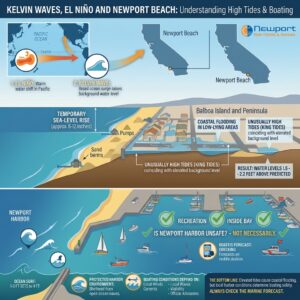
El Niño and a coastal Kelvin wave are contributing to higher-than-normal ocean water levels along the California coast. Those elevated water levels become particularly important when they coincide with exceptionally high tides. In Newport Beach, that combination has contributed to flooding in low-lying areas, especially around the Balboa Peninsula, Balboa Island and other waterfront locations.
But a higher ocean water level does not automatically mean that conditions inside Newport Harbor are unsafe for recreational boating.
To understand why, it helps to separate three different things: the background rise in sea level associated with El Niño and Kelvin waves, the unusually high astronomical tides occurring now, and the actual conditions experienced by a boat on the water.
What Is a Kelvin Wave?
Despite the name, a Kelvin wave is not the kind of wave most people picture when they hear the word “wave.” It is not a breaking wave that travels toward the beach and crashes into boats or seawalls. An oceanic Kelvin wave is an extremely long, slow-moving movement of warm water that can travel thousands of miles across the Pacific. During El Niño development, changes in tropical Pacific winds can help push warm water eastward. As that water reaches the eastern Pacific, the resulting Kelvin wave can travel along the coastline toward North America.
NOAA explains that coastal Kelvin waves can temporarily raise sea levels along the U.S. West Coast. They can increase coastal water levels by roughly 6 to 12 inches, although the exact effect varies by location and conditions.
This distinction is important. A Kelvin wave does not arrive at Newport Beach as a giant moving wall of water. Instead, it can raise the overall level of the ocean for a period of time. Think of it as raising the baseline rather than creating a giant wave.
How Does El Niño Fit Into the Picture?
El Niño is a large-scale climate pattern involving unusually warm ocean temperatures in the tropical Pacific. Those changes affect atmospheric circulation, ocean currents and conditions across much of the Pacific basin. For Southern California, one consequence can be higher coastal water levels.
Warmer ocean water occupies more space than colder water, and El Niño can also alter currents and atmospheric conditions that influence coastal sea levels. When those elevated water levels occur at the same time as an unusually high tide, the effects can become much more noticeable.
That is essentially what Newport Beach is experiencing now.
The City of Newport Beach reports that observed ocean water levels have recently been approximately 18 to 22 inches above predicted astronomical tides. The City has warned that similarly elevated conditions can significantly increase flooding risk in low-lying areas.
The National Weather Service has also reported that observed tides in Orange County have recently been approximately 1.5 to 1.7 feet above predicted levels.
Why Is Newport Beach Flooding?
The flooding is not caused by one factor alone. Several factors can combine: El Niño can contribute to elevated ocean water levels. Coastal Kelvin waves can temporarily raise sea level along the West Coast. Astronomically high or “King” tides can push water levels significantly higher. Large surf can add water and wave energy along exposed sections of the coastline. Storms, wind and atmospheric pressure can further change coastal water levels.
When these factors overlap, areas that normally remain dry can experience flooding. That is why a relatively small increase in average water level can have a surprisingly large effect during an exceptionally high tide. The difference between water remaining below a seawall and spilling onto a street can sometimes be measured in inches.
Does This Mean Newport Harbor Is Unsafe for Boating?
This is where an important distinction needs to be made. High coastal water levels and flooding do not automatically mean that every part of Newport Harbor has dangerous boating conditions.
Newport Harbor is a protected harbor environment. Recreational boats operating within the harbor are not experiencing the same conditions as a vessel operating directly in the open Pacific. A Kelvin wave does not suddenly create large breaking waves inside the harbor. El Niño does not, by itself, mean that every boat trip in Newport Harbor becomes unsafe. Instead, boating conditions need to be evaluated based on what is actually happening on the water.
Wind speed and direction, local waves, currents, visibility, conditions at the harbor entrance and any official marine or safety advisories are much more relevant to the immediate experience of a boat operator.
This is why it is possible for coastal streets to experience flooding while boats continue operating within protected harbor waters under appropriate conditions.
That does not mean conditions should be ignored. It means that flooding on land and boating conditions on the water are related but different issues.
What About the Current Newport Beach Conditions?
Newport Beach is experiencing an exceptionally high-tide period.
The Newport Beach Police Department reported that Monday’s high tide reached approximately 8.3 feet, with an 8.5-foot high tide expected Tuesday. The City has been using pumps, sand berms and sandbags in vulnerable areas while monitoring the situation.
The National Weather Service has issued a coastal flood warning for Orange County through Thursday, October 29. Its October 27 forecast showed observed tides running approximately 1.5 to 1.7 feet above predicted levels. At the same time, the forecast called for surf around 1 to 3 feet, with sets to 4 feet, along Orange County’s coast. Those numbers illustrate why it is important not to equate “high tide” with “large waves.”
They measure different things. Tide refers to the rise and fall of the ocean caused primarily by astronomical forces. Surf refers to waves generated by wind and other ocean processes.
A Kelvin wave is a large-scale movement of ocean water that can temporarily elevate sea level. These phenomena can occur together, but they are not interchangeable.
What Should Boaters Actually Watch?
For anyone planning to go boating in Newport Beach, the most useful approach is to monitor the conditions that directly affect navigation. Check the marine forecast before leaving. Look at wind conditions and expected changes during the trip. Check local tide predictions and observed water levels. Pay attention to conditions around the harbor entrance, where ocean swell can have a much greater influence than it does farther inside the protected harbor.
Follow any official closures, marine advisories or instructions from local authorities. And remember that conditions can change.
It would be incorrect to say that El Niño makes boating unsafe across Newport Beach. It would be equally incorrect to say that El Niño has no effect whatsoever on boating conditions. The reality lies between those two statements.
Why Harbor Boating Can Be Different From Open-Ocean Conditions
The geography of Newport Harbor matters. Inside the harbor, boats are operating in comparatively sheltered waters rather than directly on the exposed Pacific coastline. The harbor environment can therefore be considerably different from conditions at beaches, jetties and other exposed coastal areas.
This is especially important when people see images of flooding on city streets or large surf along the coast and assume the same conditions must exist throughout the harbor.
They do not necessarily. A flooded street is evidence of elevated water levels interacting with low-lying infrastructure. It is not, by itself, evidence that every section of Newport Harbor has unsafe boating conditions.
Similarly, a high astronomical tide does not automatically mean that a recreational boat will encounter large waves. The actual marine conditions still matter.
The Bottom Line
The current high-water situation in Newport Beach is real, and the flooding should be taken seriously. For boaters, the key question is not simply, “Is there El Niño?”
The better question is, “What are the actual conditions on the water today?”
That means checking wind, waves, currents, tides, harbor conditions and official advisories before heading out.
For visitors considering a Newport Harbor boat outing, the same principle applies: conditions should always be checked before departure, and any official safety advisory or closure should take priority.
The current flooding is a reminder that Newport Beach is a coastal community where small changes in water level can have significant effects on land. But it should not lead to the misconception that every high-water event means Newport Harbor itself is experiencing dangerous open-ocean conditions.
Understanding the difference between El Niño, Kelvin waves, tides, surf and local harbor conditions gives boaters a much clearer picture of what is actually happening and that distinction matters.